
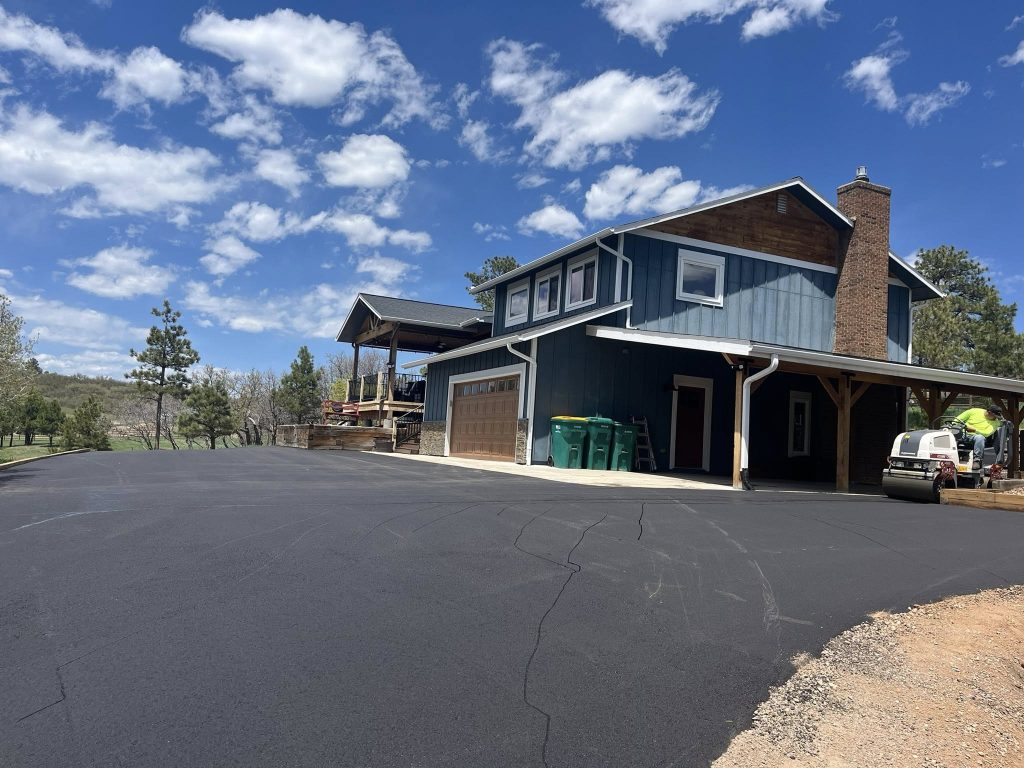
A residential asphalt driveway on the Colorado Front Range lasts 15 to 30 years when installed correctly and maintained on schedule. The lifecycle moves through five distinct phases: installation and cure, new pavement protection, mid-life maintenance, structural repair, and resurfacing or replacement. Front Range homeowners who sealcoat every 2 to 3 years and address cracks within 48 hours typically push their driveway to the top of that lifespan range. Skip maintenance and Colorado’s freeze-thaw cycles cut that timeline in half.
This guide walks you through every phase, what to expect at each one, and what it costs. The numbers and timing are calibrated to Front Range conditions, not generic national averages.
Pavement Lifecycle at a Glance
Here is the full lifecycle of a Front Range residential driveway, condensed into a single reference table.
| Phase | Years | What Happens | Typical Cost (per sq ft) |
|---|---|---|---|
| 1. Installation & Cure | Year 0 to 0.5 | Excavation, base prep, paving, 6-month cure | $3 to $7 |
| 2. New Pavement Protection | Year 1 to 3 | First sealcoat, crack monitoring | $0.25 to $0.45 sealcoat |
| 3. Mid-Life Maintenance | Year 3 to 12 | Sealcoat every 2-3 years, crack fill annually | $0.30 to $0.60 crack fill |
| 4. Structural Repair | Year 12 to 20 | Patching, larger crack repair, drainage review | $0.60 to $1.75 patching |
| 5. Resurface or Replace | Year 18 to 30+ | Overlay or full removal and repave | $3 to $10 repave |
Phase 1: Installation and Cure (Year 0 to 0.5)
The first six months determine 70% of how long your driveway will last. Cutting corners here, on base depth, compaction, or grading, sets up failure no maintenance program can reverse. Quality driveway paving starts with the work you cannot see after the asphalt is down.
What a Correct Installation Looks Like
A residential driveway built for Colorado conditions has three structural layers.
- Subgrade: native soil compacted to at least 95% standard proctor density
- Aggregate base: 4 to 8 inches of crushed road base, compacted in lifts
- Asphalt surface: minimum 3 inches of hot mix asphalt for passenger vehicles, 4 inches if you regularly park an RV, trailer, or work truck
A properly compacted aggregate base prevents water infiltration and movement, the two failure modes that kill Front Range driveways. Skip compaction and the surface looks fine for 18 months, then alligator-cracks across an entire wheel path.
The 6-Month Cure Window
New asphalt remains flexible for the first six months. During this period the binder is still volatilizing and the surface is vulnerable to point loads and chemical exposure. Three rules during cure:
- Do not park in the same spot twice. Heat plus weight equals tire imprints
- Keep heavy equipment off, including dumpsters, RVs, and concrete trucks
- Do not sealcoat. New asphalt needs to oxidize first, typically a minimum of 90 days and ideally a full Front Range summer
Phase 2: New Pavement Protection (Year 1 to 3)
First sealcoat goes down between 6 and 12 months after installation. Professional driveway sealcoating is the highest-ROI maintenance dollar you will ever spend on the driveway.
Why the First Sealcoat Matters Most
Sealcoating blocks UV radiation and repels moisture, the two forces that age asphalt fastest. According to research summarized by Asphalt Calculator USA, sealcoating every 3 to 5 years blocks roughly 85% of moisture intrusion into the pavement. On the Front Range, where Denver experiences an estimated 120 freeze-thaw days per year per CDOT climate data, that moisture block is the difference between a 15-year driveway and a 25-year driveway.
Front Range Sealcoat Timing
The Front Range has a narrower sealcoating window than most of the country. Surface temperature must hold above 50 degrees Fahrenheit for 24 hours after application, with no rain in the forecast. That gives you a working window of roughly mid-May through late September at elevations between 5,000 and 7,000 feet.
Brian Riley, owner of Riley’s Asphalt, puts it directly: “On the Front Range you get one good sealcoating window per year. Miss it and you are gambling with another full winter of UV and freeze-thaw on bare asphalt.”
Phase 3: Mid-Life Maintenance (Year 3 to 12)
This is the longest phase and the one where most homeowners lose the driveway. Sealcoat every 2 to 3 years, fill cracks the moment they appear, and the driveway stays in mid-life almost indefinitely.
The 2-to-3 Year Sealcoat Cycle
Front Range sun and altitude push sealcoat toward the lower end of the recommended interval. UV intensity at 6,000 feet is roughly 25% stronger than at sea level, which accelerates binder oxidation. Most driveways in Castle Rock, Highlands Ranch, and Parker need sealcoat at year 2, year 5, year 8, and year 11.
Crack Filling Within 48 Hours
Cracks are not cosmetic. A 1/4-inch crack lets water reach the aggregate base, where freeze-thaw expansion widens it from the inside. Untreated cracks degrade up to 60% of structural strength within two years, according to Asphalt Calculator USA’s pavement performance data. See our asphalt repair service for crack sealing and patching options.
Fill cracks wider than 1/4 inch with hot rubberized crack fill. Hairline cracks under 1/8 inch usually seal themselves when you sealcoat. Anything in between needs attention before the next freeze cycle.
Annual Inspection Checklist
Walk the driveway every spring after snowmelt. Look for:
- Cracks of any size, especially along edges and where the driveway meets the garage apron
- Surface graying, the visual signal of binder oxidation and a sealcoat trigger
- Pooling water after rain or sprinkler runoff, which signals drainage failure
- Edge ravel, where the unsupported outside edge starts to crumble
- Stains from oil, transmission fluid, or coolant, which dissolve asphalt binder
Phase 4: Structural Repair (Year 12 to 20)
Around year 12, even a well-maintained Front Range driveway starts showing structural fatigue. The fix at this stage is targeted repair, not full replacement.
Patching vs. Full Replacement
A localized failure, a single alligator-cracked area or a pothole near the street, is a patching job, not a repave. Properly installed full-depth patches restore structural integrity for $0.60 to $1.75 per square foot, a fraction of the $3 to $10 per square foot of full replacement.
When Patching Stops Working
Patching is the right call until the failed area exceeds roughly 25% of the total surface. Past that threshold, you are paying for repeated repairs that will not match cosmetically and will telegraph through any future overlay. At that point, plan for resurfacing within 12 to 24 months.
Phase 5: Resurface or Replace (Year 18 to 30+)
End-of-life arrives one of two ways: structural failure or surface failure. The fix depends on which one you have.
Overlay vs. Full Replacement
| Option | When It Works | Typical Cost | New Lifespan |
|---|---|---|---|
| Overlay (resurface) | Base is intact, surface is failing | $3 to $5 per sq ft | 10 to 15 years |
| Full removal and repave | Base failure, drainage failure, or alligator cracking over 25% of surface | $5 to $10 per sq ft | 20 to 30 years |
Front Range Replacement Cost in 2026
Colorado residential driveway paving currently runs $3 to $10 per square foot, with most projects landing between $3 and $7. A typical 600-square-foot two-car driveway costs $1,800 to $4,200 on the low end and up to $6,000 with premium thickness or difficult access. Add 10% to 15% for steep grades, retaining wall work, or removal of an existing concrete slab. See our full Cost to Pave an Asphalt Driveway in Colorado breakdown for project-specific factors.
How Colorado Front Range Climate Compresses the Lifecycle
Three Front Range climate factors push driveways toward the lower end of national lifespan averages. Understanding them is how you push your driveway toward the upper end instead.
Freeze-Thaw Cycles
Denver and the surrounding Front Range experience approximately 120 freeze-thaw days annually. Each cycle forces water trapped in pavement voids to expand by roughly 9% as it freezes, then contract on thaw. Repeated over a single winter, this turns a hairline crack into alligator cracking.
UV Intensity at Altitude
At 6,200 feet, Castle Rock receives UV radiation roughly 25% more intense than sea-level cities. UV evaporates the lighter components of asphalt binder, leaving the surface brittle. This is why Front Range driveways often need sealcoating on a 2-year cycle rather than the 3-year cycle common in the Midwest.
Temperature Swings
The Front Range routinely sees 40-degree temperature swings within 24 hours, including the famous March days that hit 70 degrees followed by 20-degree nights. Asphalt expands and contracts with every swing. Over thousands of cycles, this thermal stress fatigues the binder and accelerates cracking, especially along the driveway edges.
Total Cost of Ownership Over a 25-Year Lifecycle
Maintaining a driveway costs a small fraction of replacing one. The numbers below assume a 600-square-foot two-car driveway in Castle Rock or a comparable Front Range community.
| Year | Service | Estimated Cost |
|---|---|---|
| Year 0 | Initial paving | $2,400 to $4,200 |
| Year 1 | First sealcoat | $150 to $270 |
| Year 3 | Sealcoat | $150 to $270 |
| Year 5 | Sealcoat + crack fill | $200 to $360 |
| Year 8 | Sealcoat + crack fill | $200 to $360 |
| Year 12 | Patching + sealcoat | $500 to $1,100 |
| Year 16 | Sealcoat + crack fill | $200 to $360 |
| Year 20 | Overlay (resurface) | $1,800 to $3,000 |
| 25-year total | Maintained driveway | $5,600 to $9,920 |
Compare that to a driveway with no maintenance: typical failure by year 12 to 15, requiring full removal and repave at $3,000 to $6,000, then the cycle restarts. Over 25 years the unmaintained path costs more and produces fewer usable years of driveway.
Research published by the U.S. Government Accountability Office concluded that every dollar spent on pavement preservation can save up to six dollars in future rehabilitation costs. That 6-to-1 ratio holds for residential driveways as cleanly as it does for highways.
Warning Signs at Each Lifecycle Phase
Knowing what to look for at each stage tells you whether to monitor, schedule maintenance, or call for repair.
| Sign | Likely Phase | Action |
|---|---|---|
| Surface fading from black to gray | Phase 2 or 3 | Schedule sealcoat |
| Single hairline crack | Phase 2 or 3 | Monitor, sealcoat will fill it |
| Cracks wider than 1/4 inch | Phase 3 | Crack fill within 48 hours |
| Spiderweb (alligator) cracking | Phase 4 | Full-depth patch required |
| Potholes | Phase 4 | Patch, then investigate base |
| Edge crumbling more than 2 inches | Phase 4 or 5 | Patch and add edge support |
| Birdbaths holding water 24+ hours | Phase 4 or 5 | Drainage review, possible overlay |
| Surface failure over 25%+ of driveway | Phase 5 | Overlay or replacement |
Recommended Maintenance Schedule for Front Range Driveways
Print this. Stick it on the inside of a cabinet. It is the single document that decides whether you replace your driveway at year 15 or year 28.
- Year 0 to 0.5: Honor the cure window. No heavy loads, rotate parking spots, no sealcoat yet
- Year 1: First professional sealcoat after a full Front Range summer cure
- Every spring after snowmelt: visual inspection, photograph any cracks for tracking
- Within 48 hours of crack appearing (over 1/4 inch): hot rubberized crack fill
- Every 2 to 3 years: professional sealcoat between mid-May and late September
- Year 10 to 12: structural inspection, patch any localized failures
- Year 18 to 22: evaluate for overlay versus full replacement
When to Call a Professional
Sealcoating, crack filling, and patching all have DIY products at any home center. Some are worth attempting, most are not.
DIY-Friendly
- Filling single cracks under 1/2 inch with caulk-gun tubed crack filler
- Pressure washing the surface before a professional sealcoat to lower the contractor’s prep cost
Hire a Professional
- Sealcoating: DIY applications last 1 year. Professional applications last 2 to 3 years and cost less per usable year
- Patching: requires saw cutting, base prep, and hot mix asphalt. Professional patching holds. Cold-patch products from home centers fail within a season
- Overlay or replacement: requires tonnage of hot mix, a paver, rollers, and tight grading. Hire a driveway paving contractor; this is not a homeowner job
Frequently Asked Questions
How long does an asphalt driveway last on the Colorado Front Range?
A residential asphalt driveway on the Front Range lasts 15 to 30 years. The 30-year end requires a correct installation, sealcoating every 2 to 3 years, and crack filling within 48 hours of cracks appearing. Skip those steps and Colorado’s 120 annual freeze-thaw days cut the lifespan to 12 to 15 years.
How often should I sealcoat my driveway in Colorado?
Every 2 to 3 years. Front Range UV intensity at altitude pushes sealcoat toward the shorter interval. Sealcoat the first time at 6 to 12 months after installation, then on the 2-to-3 year cycle for the rest of the driveway’s life. The application window runs from mid-May through late September.
What does a new asphalt driveway cost in Castle Rock or the Front Range in 2026?
Colorado residential driveway paving runs $3 to $10 per square foot in 2026, with most projects between $3 and $7. A standard 600-square-foot two-car driveway typically costs $1,800 to $4,200. Add 10% to 15% for steep grades, premium 4-inch thickness, or removal of an existing concrete slab. See the full Colorado driveway cost breakdown.
Should I repair or replace my driveway?
Repair if failed areas cover less than 25% of the surface and the aggregate base is still intact. Patch if cracks are localized. Replace if cracks cover more than 25% of the driveway, if you have base failure or drainage problems, or if the driveway is past year 22 with multiple repair patches. A professional assessment costs nothing, request a free estimate before making the call.
Can I sealcoat a brand new driveway right away?
No. New asphalt needs to cure for a minimum of 90 days, and ideally a full Front Range summer, before the first sealcoat. The binder must oxidize and lose its excess volatiles first. Sealcoat too early and you trap those compounds in the surface, which causes the sealcoat to fail within a year.
What is the difference between an overlay and a repave?
An overlay adds a new 1.5 to 2-inch layer of asphalt on top of the existing surface. It works when the base is sound and only the surface has failed, and it costs $3 to $5 per square foot. A repave removes the existing asphalt down to the base (or deeper if the base failed too) and starts over. It costs $5 to $10 per square foot and gives you another 20 to 30 years.
Pavement Lifecycle Help on the Colorado Front Range
Riley’s Asphalt has paved and maintained residential driveways across the Front Range since 1993. As a second-generation, family-owned company based in Castle Rock, the team understands exactly how Colorado’s freeze-thaw cycles, UV intensity, and temperature swings shorten or extend a driveway’s lifecycle. Every estimate is free and includes a lifecycle assessment of your existing pavement. See examples of completed work in the project gallery.Service area: Castle Pines, Centennial, Colorado Springs, Denver, Highlands Ranch, Larkspur, Littleton, Lone Tree, Morrison, and Parker. See the full service area for all communities served on the Front Range.