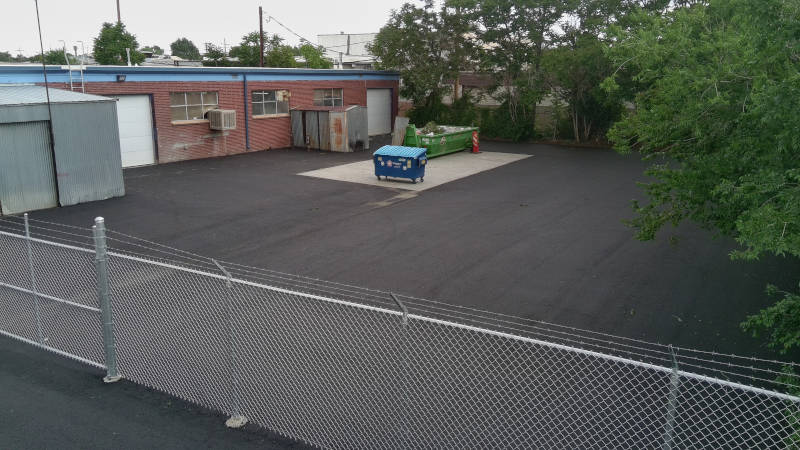
Yes. A properly installed asphalt overlay extends parking lot or driveway life by 8 to 15 years in Castle Rock, at roughly 30-50% the cost of full replacement, provided the existing base is still structurally sound. The catch is that overlay is a surface-level fix, not a foundation repair, so it only delivers those gains when the layers beneath the asphalt are intact.
Castle Rock pavement faces a uniquely harsh test. The town sits at 6,224 feet of elevation, absorbs more than 100 freeze-thaw cycles per year, and rests on the Dawson Arkose formation, a fine-grained sandstone that shifts with seasonal moisture. That combination breaks down asphalt faster than mild-climate regions, which makes overlay timing a critical decision for property owners trying to stretch maintenance dollars.
Riley’s Asphalt has assessed and installed overlays across Douglas County for more than 30 years. The guide below explains exactly when overlay works in Castle Rock, when it does not, and how to make the calculation.
What Is an Asphalt Overlay?
An asphalt overlay is a 1.5 to 3 inch layer of new hot-mix asphalt installed directly over an existing pavement surface. It bonds to the old asphalt through a tack coat, restoring up to 70-90% of pavement functionality without the cost or downtime of full reconstruction.
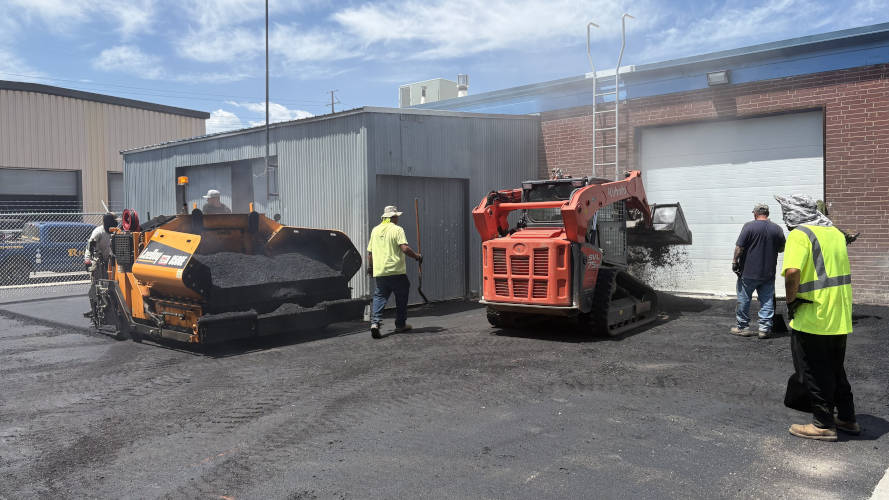
Overlay is technically different from sealcoating, which is a thin liquid protective film. Sealcoating is a maintenance product. Overlay is a structural rehabilitation that gives you a fresh driving surface.
Overlay is also different from full-depth replacement, which removes everything down to the aggregate base or subgrade and rebuilds from scratch. Overlay leaves the old asphalt in place and adds a new wearing course on top.
How Many Years of Pavement Life Does Overlay Add in Castle Rock?
A correctly installed overlay adds 8 to 15 years of service life in Castle Rock, with the average commercial lot landing around 10-12 years before the next major intervention. That figure is consistent with Asphalt Institute performance data and with what Riley’s Asphalt has documented locally across three decades of projects.
Several factors determine where your specific lot falls in that range:
- Subgrade condition before the overlay (sound base = 12-15 years; marginal base = 8-10 years)
- Traffic volume and vehicle weight (passenger cars vs. delivery trucks dramatically change wear)
- Drainage quality on the lot (standing water shortens overlay life by 30-40%)
- Whether you sealcoat the overlay every 2-3 years (extends life by 30-40% per industry research)
- Quality of the milling and tack coat application during installation
In Castle Rock specifically, overlays that get crack-sealed annually and sealcoated on a 2-3 year cycle consistently push toward the 15-year upper end. Lots that skip post-overlay maintenance typically fail in the 8-10 year range.
When Does Overlay Work and When Do You Need Full Replacement?
Overlay works when less than 25-30% of the lot shows surface distress and the underlying base is stable. Above that threshold, or when the base itself has failed, full reconstruction is the more cost-effective long-term choice.
Use this decision table to gauge which path your pavement is on:
| Condition | Overlay Candidate | Replacement Needed |
| Surface cracking | Hairline to moderate cracks under 25% of area | Alligator cracking, deep cracks over 25-30% |
| Base condition | Stable, no soft spots underfoot | Pumping, settlement, or visible base failure |
| Potholes | Few, isolated, patchable | Recurring potholes in same locations |
| Drainage | Water sheds correctly off the surface | Standing water pooling, ponding zones |
| Pavement age | Under 20 years old | Over 25 years, multiple overlays already done |
| Elevation/grade | Room to add 2 inches without curb conflicts | Existing pavement flush with curbs/concrete pans |
If three or more rows fall in the replacement column, overlay will not give you the 8-15 year return. The underlying problems will telegraph through the new asphalt within 2-3 winters.
How Castle Rock’s Climate and Soil Affect Overlay Performance
Castle Rock’s environment is harder on asphalt than most U.S. markets, which makes pre-overlay evaluation more important here than in milder climates. Three local factors specifically influence overlay success.
Freeze-Thaw Cycles and Elevation
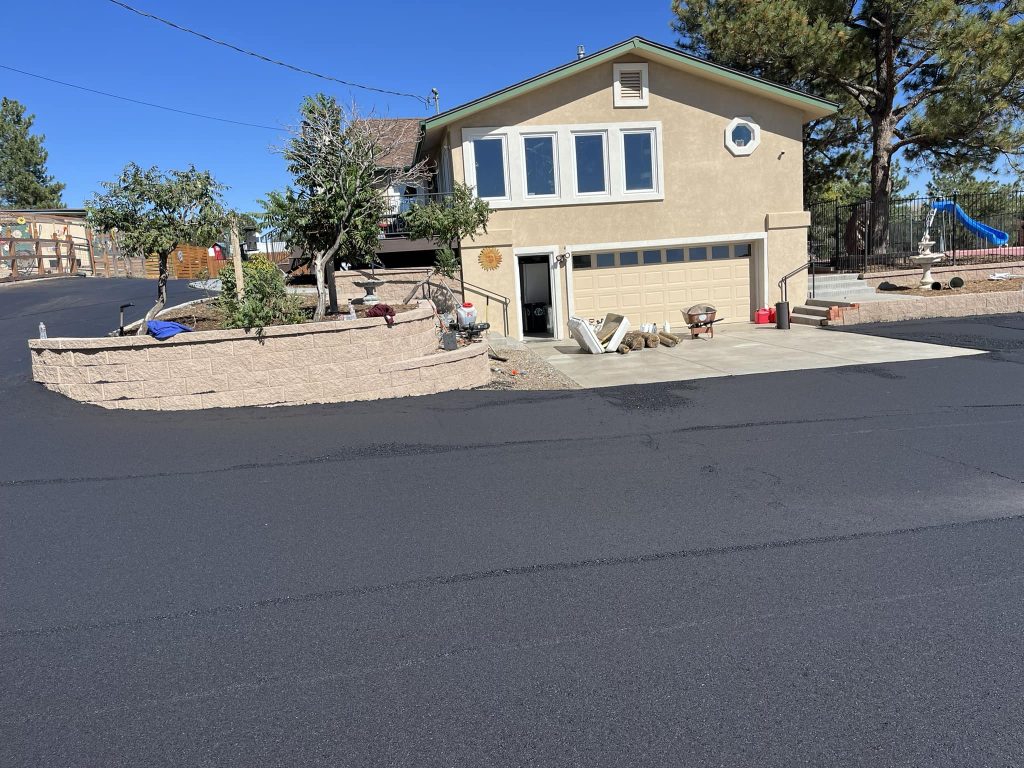
Castle Rock averages 78 inches of snow per year compared to the national average of 28 inches, according to BestPlaces climate data. The elevation drives daily temperature swings that push pavement through more than 100 freeze-thaw cycles annually.
Water that infiltrates any crack expands 9% when it freezes, prying the pavement open with each cycle. Overlay seals the existing surface, but only if the base below is dry and stable. Saturated subgrades will heave through a fresh overlay within one or two winters.
Dawson Arkose Soil and Drainage
Castle Rock sits on the Dawson Arkose formation, a fine-grained sandstone that shifts with seasonal moisture changes. Properly installed pavement uses a 6-8 inch compacted aggregate base to flex with this movement.
If your original pavement was built on inadequate base material, you will see settlement and reflective cracking patterns that no overlay can permanently mask. A pre-overlay base assessment is essential in Castle Rock, more so than in markets with stable native soils.
UV Exposure at Altitude
Castle Rock gets 243 sunny days per year. UV intensity at 6,200+ feet is roughly 25% stronger than at sea level, which accelerates oxidation of the asphalt binder. This is why post-overlay sealcoating is not optional in Colorado. It is the single biggest determinant of whether your overlay lasts 8 years or 15.
Mill and Overlay vs. Straight Overlay: Which Is Right for Your Lot?
Mill and overlay removes a 1.5-2 inch layer of the existing surface before paving, which prevents reflective cracking and resets pavement elevation. Straight overlay simply paves over the existing surface, which is cheaper but only appropriate in limited situations.
| Factor | Straight Overlay | Mill and Overlay |
| Lifespan | 6-10 years | 10-15 years |
| Reflective cracking | Likely within 2-3 years | Significantly reduced |
| Elevation impact | Raises lot by 1.5-3 inches | Maintains original grade |
| Best for | Smooth surface, minimal cracking, no curb conflicts | Rutted, cracked, or uneven pavement; lots flush to curbs |
For most Castle Rock commercial properties, mill and overlay is the right choice. The extra cost pays for itself by avoiding curb-line drainage issues and by extending the overlay’s effective life by 50-60%.
The Asphalt Overlay Process Step by Step
A professional overlay project in Castle Rock typically takes 1-3 days for a standard commercial lot, depending on square footage and prep work. Here is what the process looks like:
- Site evaluation and core sampling. Riley’s Asphalt inspects the surface and may pull a 4-inch core to verify base condition before quoting the job.
- Surface preparation. The lot is cleaned, vegetation removed from any cracks, and oil stains are treated so they do not bleed through the new surface.
- Crack repair and patching. Cracks wider than 1/4 inch get hot-pour rubberized crack sealant. Potholes get cold or hot patch as appropriate.
- Milling (if applicable). A milling machine removes 1.5-2 inches of the existing surface, exposing a clean substrate.
- Tack coat application. A liquid asphalt emulsion is sprayed to bond the new layer to the existing surface.
- Paving. Hot-mix asphalt is laid by paver in 1.5-3 inch lifts and rolled to proper density (typically 92-97% of maximum theoretical density).
- Compaction and finish rolling. Multiple roller passes lock the aggregate matrix into place.
- Striping and cure. Allow 48-72 hours minimum before reopening to vehicle traffic. New striping is applied once the surface has cooled and stabilized.
How to Maximize Overlay Lifespan in Colorado
An overlay is an investment. Protect it with these five practices:
- Sealcoat 6-12 months after the overlay, then every 2-3 years. This is the single highest-ROI maintenance step in Castle Rock’s climate.
- Seal new cracks within 60 days of appearance. Crack sealing costs roughly $1-$3 per linear foot and prevents water from reaching the substrate.
- Clear snow with rubber-edged plow blades or skid plates. Steel blades scrape the wearing course and shorten overlay life.
- Avoid magnesium chloride and calcium chloride deicers when possible. They accelerate binder breakdown. Sand or sodium chloride are gentler on asphalt.
- Inspect after every spring thaw. Catch new cracks, raveling, or low spots early when they cost dollars to fix instead of thousands.
Sealcoating is so important to overlay performance that it deserves its own consultation.
Frequently Asked Questions
How thick should an asphalt overlay be in Castle Rock?
Most Castle Rock commercial overlays are installed at 1.5-2 inches compacted thickness for parking lots and 2-3 inches for areas with truck traffic. Thinner overlays do not provide enough structural value to justify the cost in Colorado’s freeze-thaw climate. Thicker installations may be needed if the lot also functions as a delivery zone or sees heavy equipment.
Can you put an overlay on a driveway, or is it only for parking lots?
Yes, residential driveways are excellent overlay candidates when the existing asphalt is structurally sound. A driveway overlay typically takes 4-6 hours of work for an average Castle Rock home, depending on square footage. The same 8-15 year life expectancy applies.
How long do I have to wait before driving on a new overlay?
Wait at least 48-72 hours before passenger vehicles, and 14 days before heavy trucks or RVs. The surface needs to cool to ambient temperature and the asphalt binder needs time to set. Hot days slow this process. Driving on overlay too early causes tire imprints, power-steering scars, and uneven compaction that shortens lifespan.
Will overlay hide cracks permanently?
Mill and overlay significantly reduces reflective cracking by breaking the stress patterns at the surface, but no overlay completely eliminates the risk. Cracks in the original pavement, especially those caused by base movement, will often reappear in the new surface within 3-5 years. Crack sealing the original surface before overlay and using a geotextile interlayer can extend that timeline.
Can I add a second overlay later, or am I locked into full replacement next time?
Multiple overlays are possible, but cumulative elevation becomes a problem. Each overlay adds 1.5-3 inches of pavement height. After two or three overlays, the lot may sit above curbs, drains, or building thresholds. At that point, mill and overlay or full replacement becomes the only option to maintain proper grades.
Does overlay work in winter, or do I have to wait until spring?
Overlay installation requires air temperatures of at least 50°F sustained for 24 hours and pavement temperatures above 40°F. In Castle Rock, that effectively limits overlay season to mid-April through mid-October. Winter installation is not feasible because cold pavement prevents proper bonding between the new and existing asphalt layers.